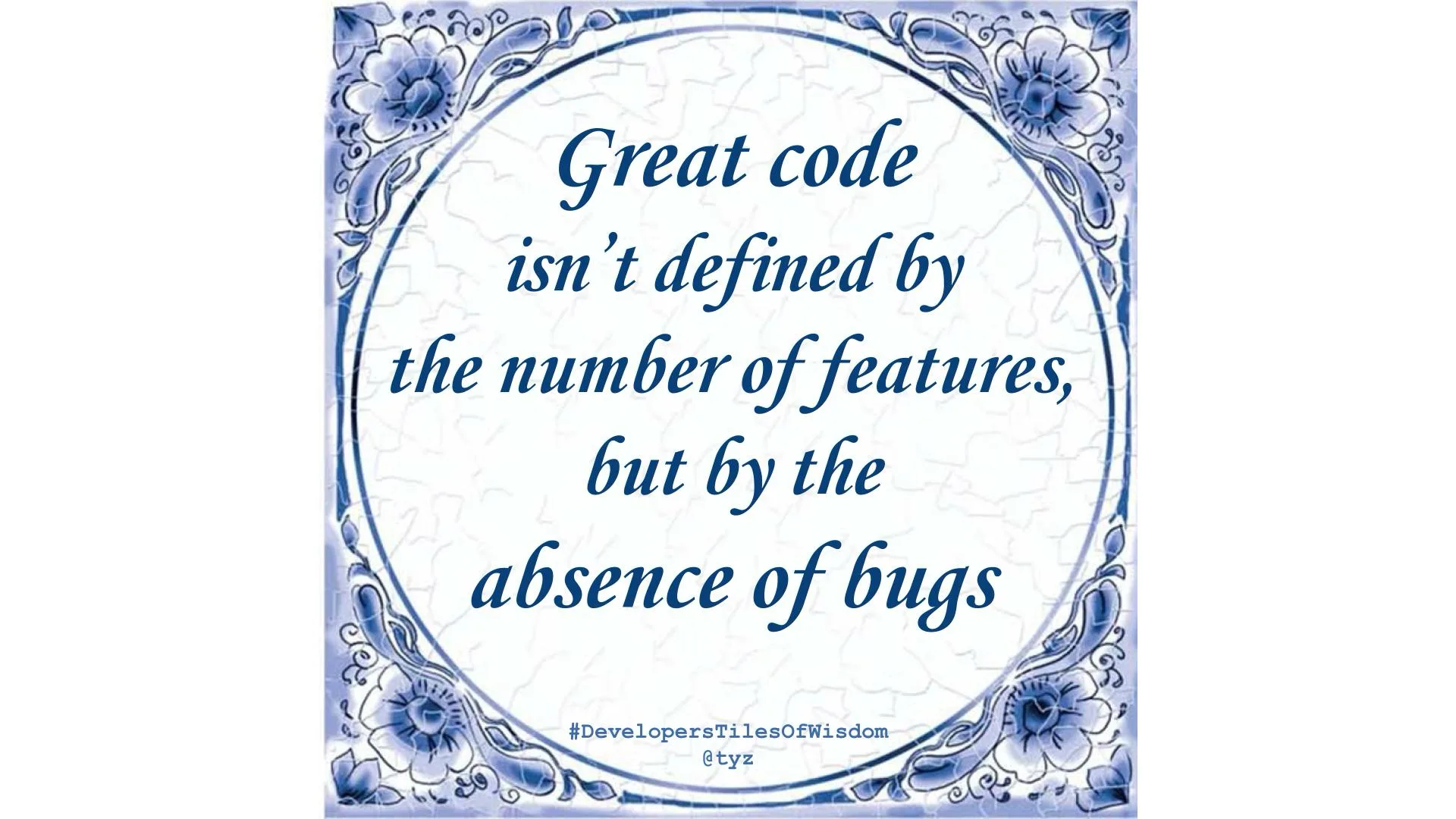
1. Great Code Isn't Defined by the Number of Features, but by the Absence of Bugs
Why solid, clean, bug-free code beats feature count — and the questions a lead developer asks before adding anything new.
Too often, the focus in development is on building new features, while the quality of the existing code fades into the background. But every new feature impacts the existing codebase.
And there's nothing more frustrating than bugs appearing in functionality that used to work perfectly but suddenly breaks due to a new addition.
Good code isn't the code with the most features. It's code that is solid, clean, and bug-free—code your team can rely on. Focus on quality, not quantity!
Questions I Ask as a Lead Developer When Adding New Features
- 💡 Does the current codebase support this functionality, or can we minimize the impact with small adjustments?
- 💡 To what extent do these new features fit into the existing codebase, or is refactoring needed?
- 💡 Do we need to resolve technical debt before expanding?
- 💡 Are there enough tests and processes in place to ensure stability?
- 💡 Is there time to test not only the new feature but also existing functionality?
By asking these questions, you ensure that new additions strengthen the codebase rather than weaken it. Small, iterative steps are key: build upon a stable foundation and test not only what's new but also what's already there.
Developers Tiles of Wisdom
In my 25+ years as a web developer—15 of which as a lead—I've worked on countless projects, collaborated with many different developers, seen an enormous amount of code, and solved a lot of problems.
Many of those problems could have been avoided if the developer (which was often me) had followed a few simple but powerful rules. Rules that are universal, independent of programming language or technology.
Rules so important that you'd want to put them on a tile on your wall.
Just like the Dutch Tegeltjeswijsheid (Tile Wisdom), but for developers: Developers Tiles of Wisdom.
Over the years, I've gathered many of these insights, and because they've helped me tremendously, I believe others can benefit from them as well. That's why I'm going to share them with you.
Each week, I'll share a Developers Tile of Wisdom, with explanations and concrete real-world examples.
This first insight is the foundation for everything that follows. Everything you do as a developer—from choosing good names to writing clear tests—aims to keep your code clean, solid, and bug-free.
What's Your Experience?
How do you balance features and quality? Have you experienced a situation where focusing on features undermined quality? Or where a minimalist approach led to success? These are worth reflecting on the next time you weigh shipping more against shipping better.
Would you like higher quality in your projects and fewer bugs? Feel free to reach out—I'd be happy to help!
Follow me for more Developers Tiles of Wisdom.