- English
- Nederlands
Lees dit artikel in het Nederlands →
25 Years as a Developer: From Notepad and IE6 to TypeScript and AI
From Notepad, tables and Internet Explorer 6 to TypeScript, Git and AI: 25 years of web development — and what never changed along the way.
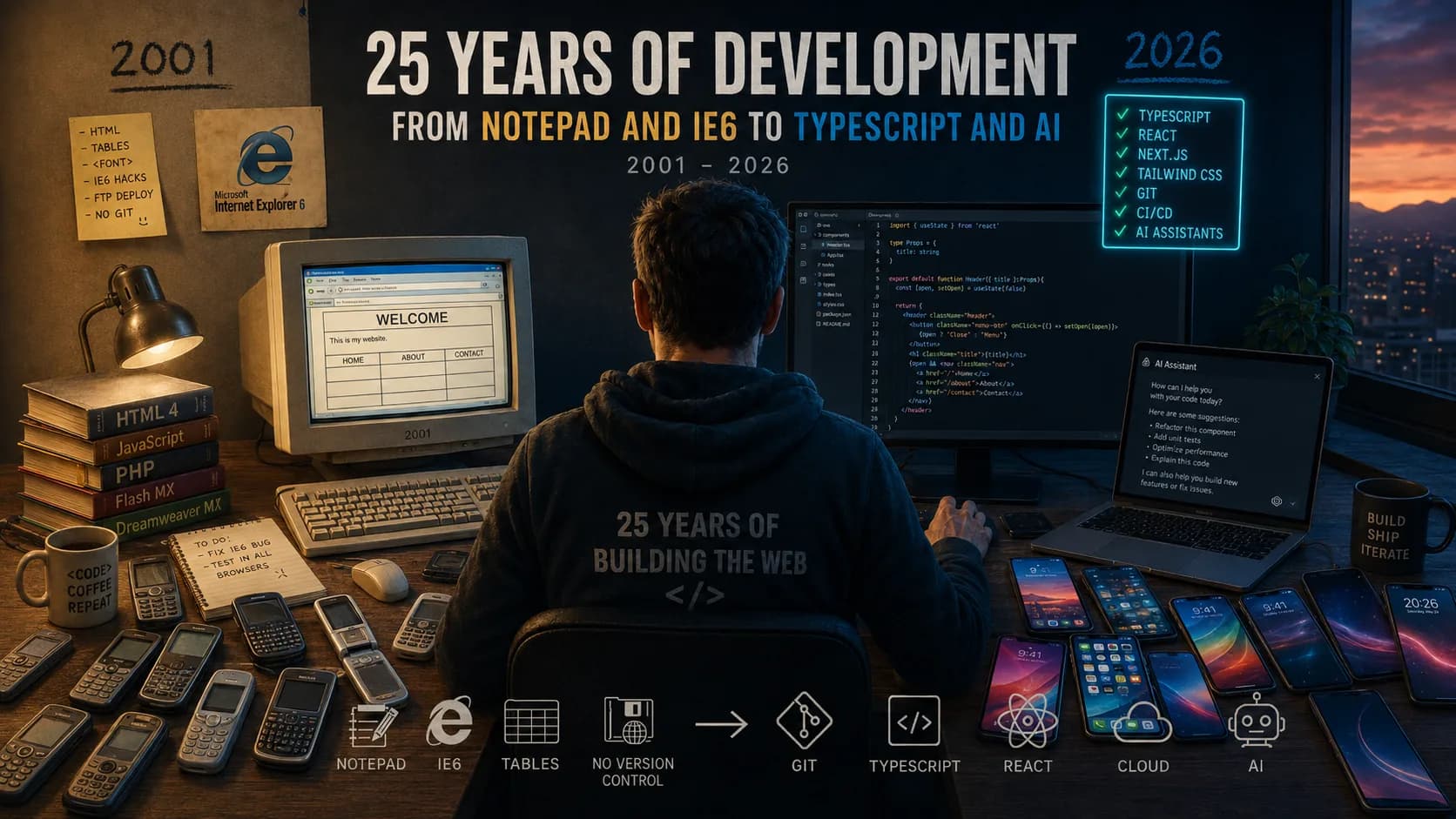
Today, on September 1st, I have been a developer for exactly 25 years.
That is a strange thing to sit with. Not only because 25 years is a long time, but mostly because the job I started out in barely resembles the one I do today. I began in 2001, while I was still studying. At first I built 3D games in Virtools, but the web pulled me in fast. Making websites felt a little like magic: you typed something into a text file, put it on a server, and suddenly the whole world could look at it.
Web development was a different craft back then. At school we weren't even allowed to use CSS yet. You styled things directly in your HTML, with <font>, color and a pile of attributes we would strip out of a codebase on sight today. For layout you used tables. Not because there was tabular data on the page, but because that was simply how you got elements where you wanted them. My development environment was Notepad. No IntelliSense. No autocomplete. No AI agents. No npm package that did exactly what you needed. Frameworks and libraries as we know them barely existed. Stack Overflow wasn't even a thing yet. You typed everything yourself. Everything.
My first projects had no version control either. No Git, no SVN. A new version meant remembering to copy the whole folder yourself, ideally into a directory whose name would still tell you something a month later. 😅 And deploying? That was its own adventure. You uploaded files over FTP, and sometimes you just edited a file straight on the production server. No pull request. No code review. No CI pipeline. No staging environment. Open the file, change it, save it, and hope you hadn't broken anything. Thinking about it now, it sounds reckless. Back then it was just development.
And once the site looked right, you were nowhere near done. The hard part came next: making it work in every browser. Internet Explorer 6 deserves a special mention here. 😬 Anyone who built websites in that era knows exactly what I mean. Browsers each interpreted HTML and CSS a little differently, and Internet Explorer usually needed hacks of its own. A site working perfectly in Firefox and falling apart completely in IE was an ordinary Tuesday. I have probably lost months of my life to browser compatibility. And as if that weren't enough, we also got the Eolas patent case, which forced Microsoft to change how interactive content like Flash worked in Internet Explorer. Overnight, enormous numbers of existing websites had to be reworked — including projects we had happily finished long ago. That kind of thing sounds almost prehistoric now.
Social media before we called it social media
Around 2002 I started Eastcore. I built the whole thing myself, from the database and backend to everything on the front end. It had user profiles, photos, chat, an event calendar and all sorts of ways to get in touch with each other. A social media platform, in other words. We just didn't call it that yet. Facebook didn't exist — it wouldn't be founded until 2004. 😉
Looking back, I still find it remarkable that I built a complete platform on my own at a time when there were hardly any frameworks, libraries or off-the-shelf services. If you needed something, you built it. And Eastcore says a lot about what I have always enjoyed most in this work: coming up with something you don't yet know how to make, and then simply making it.
After that I worked at Treshold and later at Lost Boys. Over the years I programmed in more or less everything that came past: PHP, Java, .NET, JavaScript and a great deal of Flash. Flash was fantastic at the time. You could build experiences that were simply impossible in HTML — animations, games, interactive campaigns and entire websites where you hardly felt like you were looking at a website at all. Later we would say goodbye to Flash en masse, as JavaScript and eventually HTML5, CSS and modern frontend technologies became powerful enough to do the same, and much more, straight in the browser.
Fifteen years at MediaMonks
In 2008 I joined MediaMonks. I would end up staying fifteen years. When I started, the work was hands-on: building websites and interactive campaigns. In the years that followed MediaMonks grew enormously, and my own role changed with it. I became Lead Frontend Developer, then Technical Director, and eventually Global Frontend Director. At one point I was responsible for a frontend organization of around 140 developers spread across several countries.
Even so, I never really saw myself as a manager who happened to have been a developer once. I always wanted to stay close to the technology: designing architecture, reviewing code, developing standards, coaching developers — but also just opening my editor and building. In those fifteen years I got to work on projects for a huge number of well-known brands, including Albert Heijn, Efteling, Amazon, Coca-Cola, Heineken, IKEA, Nickelodeon and Hyundai Genesis. A number of them won FWAs and other awards. 🏆
But the projects that stayed with me most are the ones everybody seemed to know. One of my favorites is the Albert Heijn collectible football card campaign. Albert Heijn is the largest supermarket chain in the Netherlands, and that season half the country was collecting football cards — the Panini-style kind you get free at the checkout and stick into a collector's album. Digitally we did something genuinely new for the time: you could create your own football card and then see it back in an interactive, personalized video. Your card became part of a commercial with famous footballers, who reacted to it as though it had always belonged in the collection.
Personalized video is nothing special now, but back then this was brand new. For its time, interactive video at this scale was genuinely groundbreaking. And it worked a little too well. People genuinely believed the video they were watching had been recorded for them. I was even called by people who wanted to know how we had managed to get professional footballers to hold up their personal card in a commercial. That is still one of the best compliments a developer can get: the technology working so well that people stop noticing there is any technology at all.
The same went for the football prediction pool on Hyves. Hyves — remember that one? 😄 Before Facebook took over here, more or less the entire country was on Hyves, the Dutch social network of its day. I built the football prediction game for Hyves, and half the Netherlands seemed to be filling in their scores. Projects like that made the period enormously fun. You sat behind your computer building something, and a few weeks later a huge slice of the country was using it.
During big football tournaments it got faintly ridiculous. You would be watching the ad breaks between World Cup matches and say, at one commercial: "we built that website." Then the next ad: "that one too." And another: "yep, that one too." At times it felt like we were behind the digital campaign of every major brand on air that summer. Those were absurd stretches of short deadlines and strange technical problems — and an enormous amount of creative freedom.
From the Netherlands to Argentina
One of the biggest changes in my life came when I moved to Argentina for MediaMonks. I lived and worked in Buenos Aires for about two years. 🇦🇷 That wasn't only a professional experience. Suddenly I was working every day with people who had a different language, a different culture and a different way of communicating. I think I learned as much there about people and teams as I did about technology.
Later I helped set up development teams in India and Kazakhstan. We did that largely remotely, long before fully remote collaboration became as normal as it is now. I learned how much culture, communication and trust matter when you work with international teams. What seems obvious in the Netherlands is not necessarily obvious on the other side of the world.
The nice thing is that some of those relationships outlast any job or project. Today I work again with Timur and Yerniyaz from Kazakhstan, who I worked with at MediaMonks years ago. These days we do projects together through my own company, Glaciavis. That may be one of my favorite things about 25 years in the same field: people disappear from view for years, and then your paths cross again.
Full circle
That happens in another way too. Right now I am working again with Roel, who I graduated with roughly 25 years ago. Back then we built the Apart Game Table together, among other things: a physical interactive game in the shape of a table, with buttons, lights and software driving all of it. For its time that was quite something, and it fit exactly what I already loved — using technology to make something people could actually experience.
Now, a quarter of a century later, we are building projects together again. The circle feels satisfyingly closed. 🔄
Meanwhile I have been independent again since 2023, working as a freelance Lead Frontend Engineer, architect and developer. I also started Glaciavis, through which I collaborate with a network of international developers. And at the moment I have several good projects running at once. That is probably the biggest difference with a few years ago: I have deliberately chosen much more hands-on development again. And it suits me very well.
25 years of change
Looking back on 25 years of development, it is almost impossible to list everything that changed. We went from sites designed for one fixed desktop resolution to responsive sites for thousands of screen sizes. From tables to CSS. From Flash to HTML5. From JavaScript without decent tooling to TypeScript.
From copying folders by hand as "version control" to Git, branches and pull requests. From uploading files over FTP — and sometimes editing production directly — to code reviews, staging environments and fully automated CI/CD pipelines. From servers under your own desk to cloud platforms that scale worldwide on their own. From websites of a few pages to enormous web applications that would once have been built as desktop software without a second thought.
We got jQuery, Angular, React, Vue, Next.js, Node.js, npm and an endless stream of frameworks and libraries that arrived, became popular, and sometimes quietly disappeared again. And now we are in the middle of what may be one of the biggest shifts of my career: AI. 🤖
From typing everything myself to programming with AI
There is something funny in the contrast. 25 years ago I typed every single line of code myself, in Notepad. Today I work with AI almost daily while programming. It writes code, generates tests, proposes refactors, produces documentation, analyzes complex code, and sometimes does in minutes what used to take hours. So I use it a lot. A lot.
But precisely because I use AI every day, I have become more convinced that experience is not becoming less important. If anything, more. AI can produce a solution at remarkable speed, but you still have to judge whether it is a good one. You need to know which architecture makes sense, which abstractions are worth having, when code is getting needlessly complex, what is secure, what will scale, and what will still be maintainable when twenty developers are working on it three years from now. And above all, you need to recognize when AI is confidently producing complete nonsense.
In 25 years I have seen a great many technologies we were sure were the future. Some of them were. Others vanished without a sound. So these days I try to be a little less impressed by the technology itself, and pay a little more attention to the problem we are trying to solve with it.
What hasn't changed
An enormous amount has changed in 25 years. The funny part is that the reason I enjoy this work has barely changed at all. I still love thinking of something and then building it. Going from an empty file to something that actually works. Running into a problem I have no idea how to solve, and then having that small moment a few hours later when everything clicks.
I still enjoy good architecture, code that becomes dramatically simpler after a refactor, and an interface that responds exactly the way it was meant to. And yes, I can still get far too worked up about the name of a variable, or a piece of code I think could be just a little more elegant. 😉
I still program. I still learn. And maybe most importantly: I still get an enormous amount of pleasure out of building websites and web applications.
When I sat typing my first code into Notepad in 2001, I could not possibly have predicted what my career would look like. That I would live in Argentina. Set up teams in India and Kazakhstan. Work on projects for global brands. Build things that millions of people in the Netherlands used. Guide hundreds of developers. Eventually start my own company. Or that 25 years later I would be writing code alongside artificial intelligence.
I have no idea what we will be using 25 years from now. Developers will probably look at React and TypeScript the way I now look at <font color="red">. But if in 2051 I can still build something with the same enthusiasm — something that yesterday was only an idea — I'd gladly take that.
Here's to the next 25 years. 🚀